
Pre-First World War
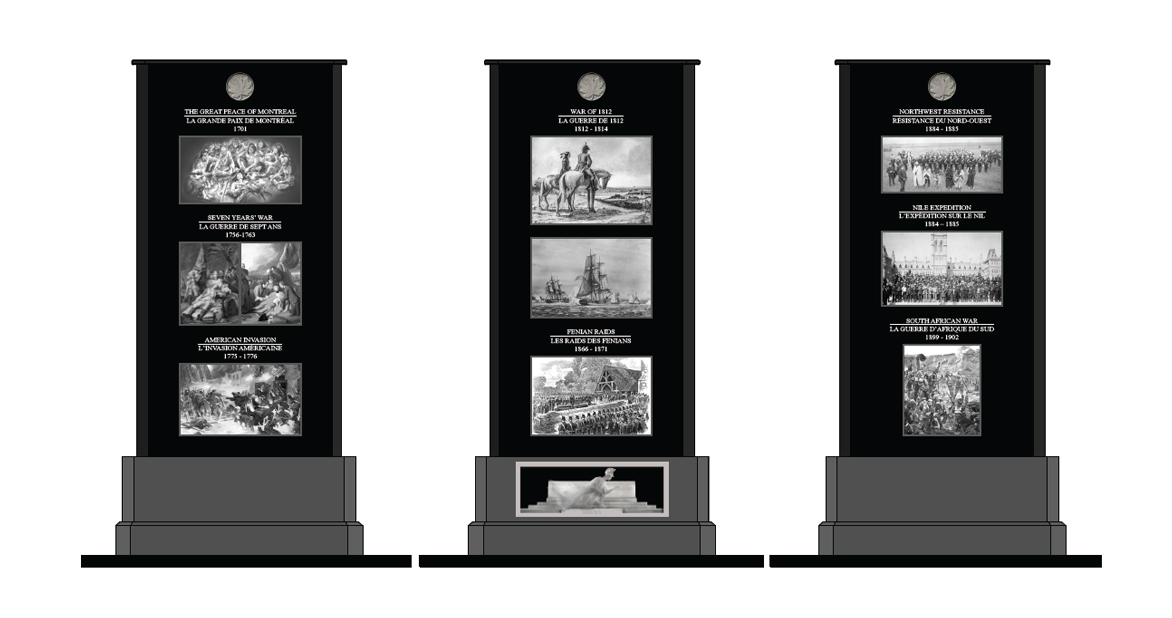
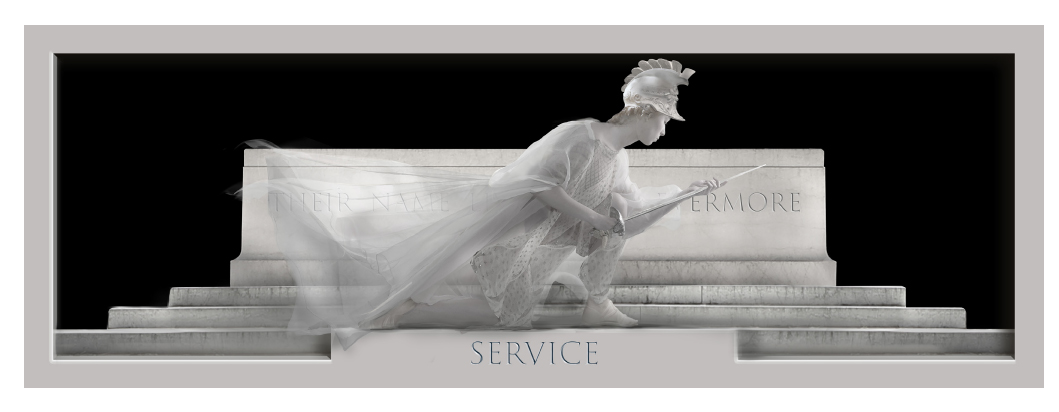
From the early 1700s through the late 19th century, the lands that became Canada were shaped by war, diplomacy, and fragile alliances. Indigenous nations, French and British empires, and later colonial communities fought, negotiated, and endured through cycles of conflict and peace. The War of 1812, the Fenian Raids, and the Northwest Resistance revealed both resilience and division, while overseas service tied Canada to imperial campaigns abroad. Across these struggles, remembrance took root, through songs and stories in Indigenous traditions, civic funerals and local memorials in communities across the growing country, laying the foundation for how Canadians would honour sacrifice in the century to come.
PANEL ONE
THE GREAT PEACE OF MONTREAL 1701
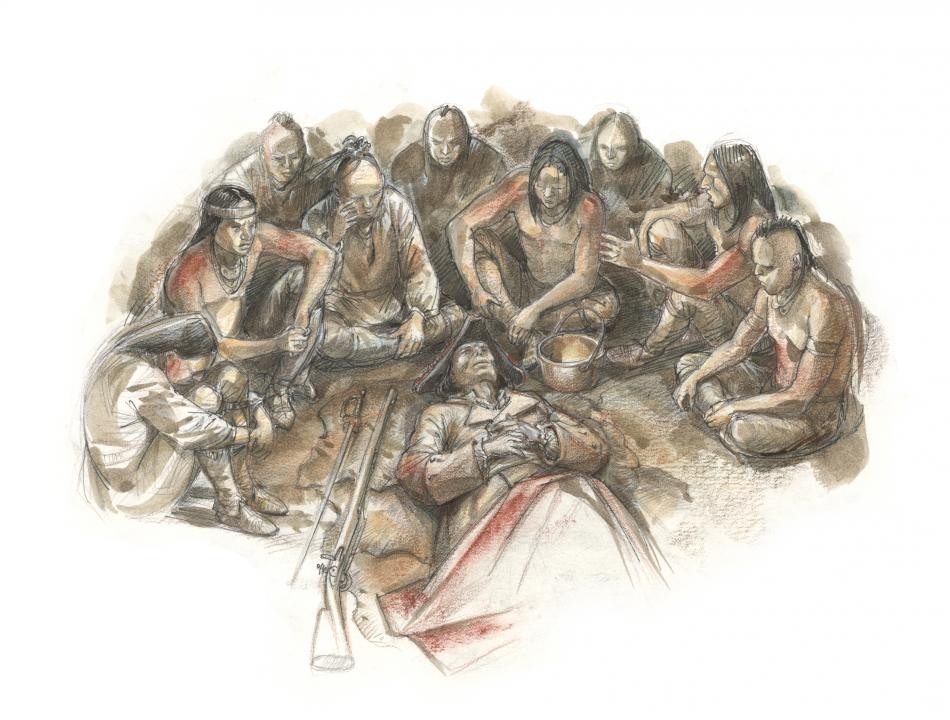
Francis Back ©, used with permission of Raphaëlle & Félix Back
In the 18th century, North America was a landscape of shifting alliances and imperial rivalry. Indigenous nations played decisive roles as diplomats and warriors, forging treaties and shaping outcomes in conflicts that pitted France and Britain for control of the continent. From the Great Peace of Montréal in 1701 to the bloody struggles of the Seven Years’ War and the American Revolution, diplomacy and war were inseparable. These encounters brought both survival and loss: futures reshaped by treaties, victories, and defeats, and memories preserved in oral tradition as well as in stone. At the dawn of the 18th century, war and shifting alliances shaped life around the Great Lakes and St. Lawrence. The Wendat statesman Kondiaronk emerged as a key advocate for peace, helping bring together more than 30 nations in Montréal in 1701.
The resulting treaty ended generations of conflict and set a precedent for diplomacy on this land. In Francis Back’s painting, Kondiaronk is shown moments after his final speech—delivered at great personal cost, for he died soon after. The image reminds us that leadership can take the form of words as much as arms, and that peace itself carries sacrifice.
The Battle of the Plains of Abraham on 13 September 1759 , proved decisive in the struggle for North America. In less than an hour, British troops forced the French army from the field, opening the way to the fall of Québec and, eventually, all of New France. General James Wolfe was mortally wounded in the victory, his death captured in Benjamin West’s famous painting and engravings. Shown here in heroic fashion, Wolfe’s passing came to symbolise both triumph and sacrifice, a reminder that the conquest of Québec was secured at high cost for commanders, soldiers, and communities alike. Though idealized, the image became iconic, symbolizing both the victory and the human cost that shaped Canada’s colonial past.
The resulting treaty ended generations of conflict and set a precedent for diplomacy on this land. In Francis Back’s painting, Kondiaronk is shown moments after his final speech—delivered at great personal cost, for he died soon after. The image reminds us that leadership can take the form of words as much as arms, and that peace itself carries sacrifice.
The Battle of the Plains of Abraham on 13 September 1759 , proved decisive in the struggle for North America. In less than an hour, British troops forced the French army from the field, opening the way to the fall of Québec and, eventually, all of New France. General James Wolfe was mortally wounded in the victory, his death captured in Benjamin West’s famous painting and engravings. Shown here in heroic fashion, Wolfe’s passing came to symbolise both triumph and sacrifice, a reminder that the conquest of Québec was secured at high cost for commanders, soldiers, and communities alike. Though idealized, the image became iconic, symbolizing both the victory and the human cost that shaped Canada’s colonial past.
Explore Further:
Pointe-à-Callière Museum - Kondiaronk, broker of the Great Peace of MontréalTHE SEVEN YEARS WAR 1756 – 1763
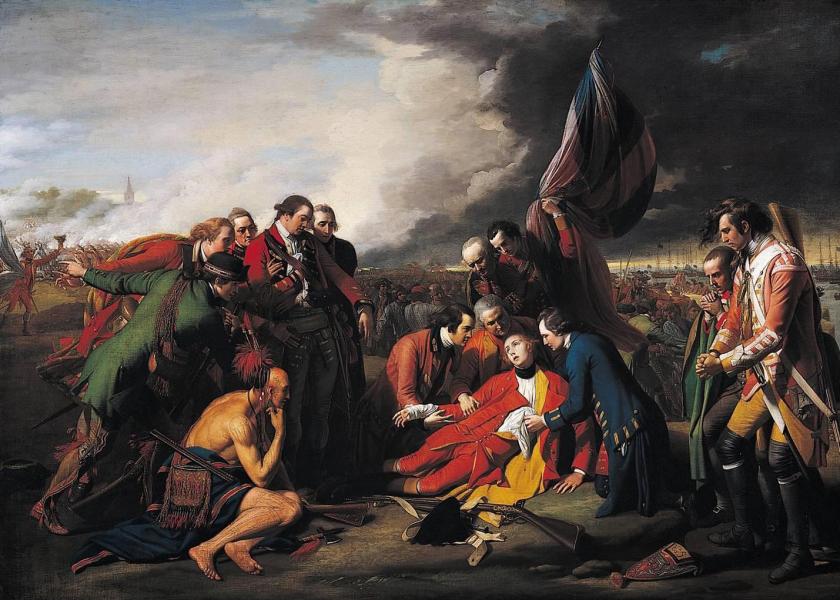
Library and Archives Canada, R13133-378, C-012248 - After the painting by
Benjamin West, engraved by William Woollett in England (1776) and widely
reproduced in Europe. Version first published in Paris by Augustin Le Grand.
Historical Context:
Benjamin West, engraved by William Woollett in England (1776) and widely
reproduced in Europe. Version first published in Paris by Augustin Le Grand.
Historical Context:
The Battle of the Plains of Abraham on 13 September 1759 , proved decisive in the struggle for North America. In less than an hour, British troops forced the French army from the field, opening the way to the fall of Québec and, eventually, all of New France. General James Wolfe was mortally wounded in the victory, his death captured in Benjamin West’s famous painting and engravings. Shown here in heroic fashion, Wolfe’s passing came to symbolise both triumph and sacrifice, a reminder that the conquest of Québec was secured at high cost for commanders, soldiers, and communities alike. Though idealized, the image became iconic, symbolizing both the victory and the human cost that shaped Canada’s colonial past
Explore Further:
Royal Museums Greenwich – The Death of General WolfeNational Gallery of Canada - The Death of General WolfeCanadian War Museum – Battle of the Plains of AbrahamCanadian War Museum – The Seven Years’ War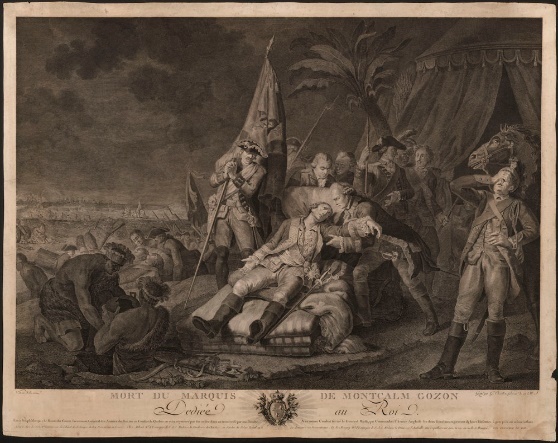
Library and Archives Canada, Acc. No. R9266-3091, e10947354. Anonymous,
after Richard Paton (c. 1780).
after Richard Paton (c. 1780).
For the French, the Plains of Abraham meant both defeat and deep loss. Commander Louis-Joseph de Montcalm was mortally wounded in the battle and died within Québec’s walls the following morning. His death marked not only the city’s fall but also the effective end of France’s military presence in Canada. This engraving presents Montcalm as a patriotic martyr, attended by grieving officers. While stylized for European audiences, the image conveys the profound human cost of the struggle and the resilience of French-speaking communities, whose culture and traditions endured despite the collapse of imperial rule.
Explore Further:
National Battlefields Commission – Plains of AbrahamLa Bibliothèque nationale de France – The Fall of New FranceLibrary and Archives Canada – Montcalm Collection (Image Record)AMERICAN INVASION 1775
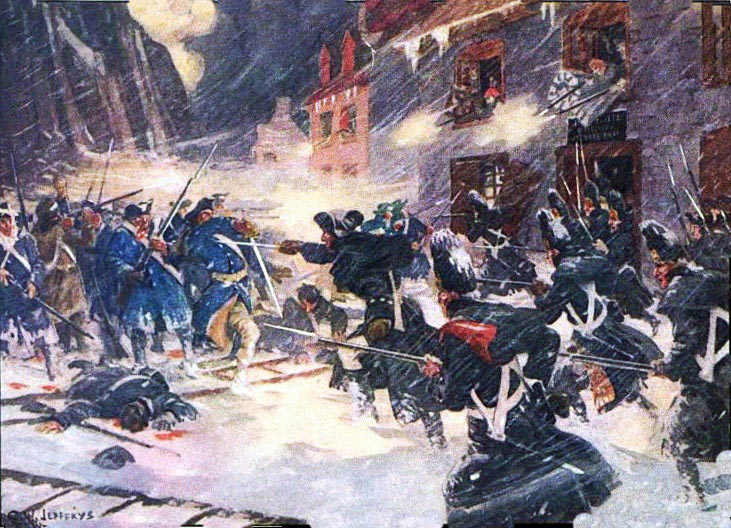
Charles William Jefferys, “Arnold’s column is shattered in fierce street fighting during the Battle of Québec,” 1916. Public Domain.
In December 1775, during the American Revolution, Continental troops under Benedict Arnold stormed the snowbound streets of Québec City. Their aim was to draw Canada into rebellion, but the attack collapsed in fierce urban fighting. Arnold was wounded, his men captured, and the city held fast. Charles William Jefferys’ 1916 illustration dramatizes the chaos: soldiers advancing through blinding snow, defenders firing from windows, fallen bodies in the streets. It captures both the desperation of the attackers and the resolve of the city’s defenders: British regulars, French-Canadian militia, and civilians united in one of Québec’s gravest tests since 1759.
Explore Further:
Canadian War Museum - American Invasion 1763-1776Military History - 1775/76 Battle for QuebecLegion Magazine – The American InvasionPANEL TWO
THE WAR OF 1812
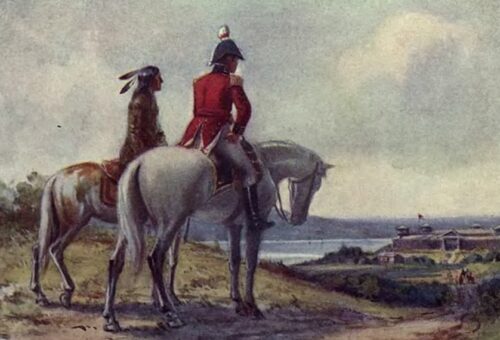
Alfred Morton Wickson, from The Story of Tecumseh by Norman S. Gurd, Toronto: W. Briggs, 1912. Public domain
The War of 1812 brought together British forces, Canadian militia, and Indigenous nations against American invasion. One of the most celebrated moments came in August 1812, when Major-General Isaac Brock and Shawnee leader Tecumseh combined their forces at Detroit. Their alliance and bold manoeuvres convinced the Americans to surrender without a major battle, securing western Upper Canada. This illustration honours the partnership of two leaders who shared courage and vision, though both would soon fall in battle. It reflects how Indigenous and European allies shaped Canada’s early survival and left a lasting legacy of sacrifice and memory.
Explore Further:
Canadian War Museum – 1812 Virtual ExhibitionLegion Magazine – The Siege of DetroitArchives of Ontario – The War of 1812U.S. National Parks Service – Brock Meets Tecumseh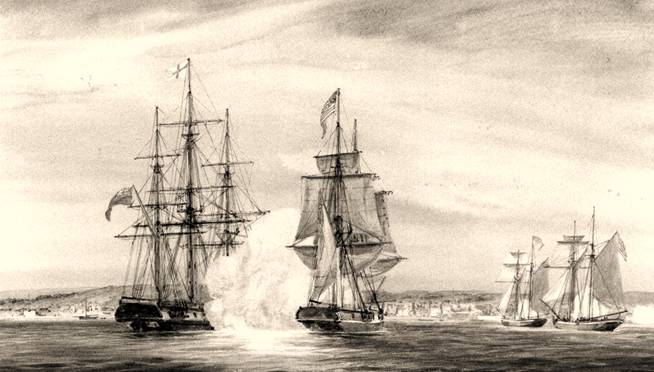
Engagement of the American Brig Oneida and British Corvette Royal George in Kingston Harbour, Upper Canada – Library and Archives Canada, Acc. No.
1970-188-487, C-040593. Public domain.
1970-188-487, C-040593. Public domain.
War also came to the waters of the Great Lakes. In November 1812, American ships pursued the British corvette Royal George into Kingston Harbour, where fierce exchanges of fire lit up the shoreline. Supported by powerful shore batteries, Kingston’s defenders forced the enemy to withdraw, keeping the harbour secure as a vital naval base. This painting shows ships locked in smoke and gunfire, with townspeople, sailors, and soldiers alike contributing to the fight. It reflects how local communities and naval forces together defended the frontiers of Canada during the War of 1812.
Explore Further:
Legion Magazine – 1812: The War That Saved CanadaWar of 1812 BicentennialU.S. Naval Institute – A British View of the Naval War of 1812Canadian War Museum – 1812 Virtual ExhibitionThe Canadian Encyclopedia – War of 1812THE FENIAN RAIDS 1866 -1871
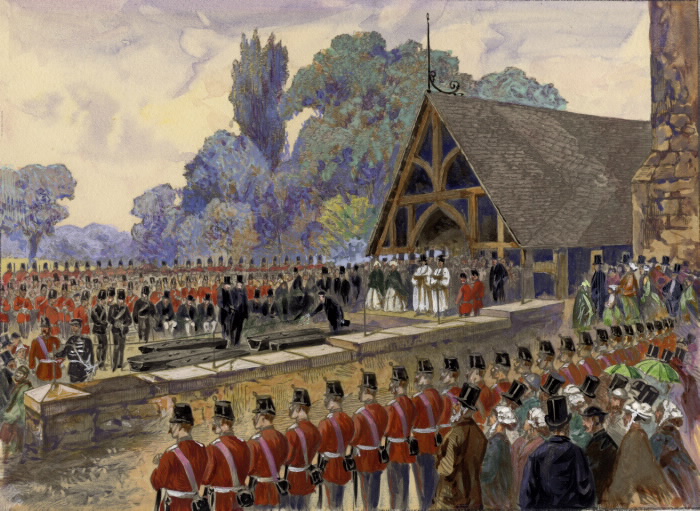
Funeral of Canadian Volunteers Killed in a Skirmish with the Fenians: Scene in
the Cemetery at Toronto [St. James Cemetery] – Illustrated London News, 30
June 1866. Baldwin Collection, Toronto Public Library, PICTURES-R-1197.
the Cemetery at Toronto [St. James Cemetery] – Illustrated London News, 30
June 1866. Baldwin Collection, Toronto Public Library, PICTURES-R-1197.
The Fenian Raids of the 1860s brought conflict to Canadian soil as Irish-American US Civil War veterans crossed the border to pressure Britain over Ireland’s independence. At Ridgeway, near Niagara, inexperienced Canadian volunteers faced heavy losses. Nine were killed and dozens wounded, their sacrifice marking one of the first times Canadians buried their fallen in a public civic ceremony. This illustration of their funeral shows soldiers and civilians gathered in solemn tribute. More than grief, it symbolised the beginnings of a national tradition of remembrance, a collective way of honouring those who gave their lives in defence of their communities.
Explore Further:
Queens Own Rifles of Canada Regiment Museum–The Fenian Raid 1866Canadian War Museum – The Fenian RaidsOntario Heritage Trust – Battle of RidgewayLegion Magazine – The Battle of RidgewayPANEL THREE
THE NORTHWEST CAMPAIGN 1884-1885
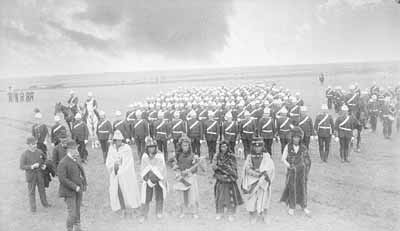
Oliver Buell, Chief Payipwat and Plains leaders with Edgar Dewdney and the Montreal Garrison Artillery, 1885. Canadian War Museum, George Metcalf Archival Collection, 19820153-010. Public domain.
The Northwest Resistance erupted in 1885 as Métis and Plains Indigenous communities defended their lands and ways of life against federal expansion. Rapidly deployed troops suppressed the uprising, leaving grief and division in its wake. This photograph shows Cree Chief Payipwat and other leaders beside colonial officials and militia, a stark image of diplomacy in the shadow of defeat. It reflects both the dignity of Indigenous leadership and the imbalance of power in the aftermath, when promises were broken and mistrust deepened. The scene reminds us that sacrifice and loss were felt on all sides of Canada’s early conflicts.
Explore Further:
Indigenous Peoples Atlas of Canada – 1885 Northwest ResistanceEncyclopedia of the Great Plains - PayipwatIndigenous Saskatchewan Encyclopedia – North-West ResistanceCanadian War Museum – The Northwest Campaign 1884-1885NILE EXPEDITION 1884 – 1885
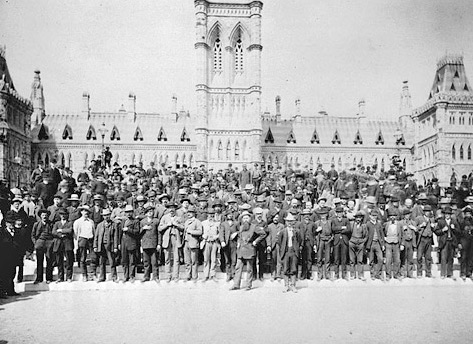
William Notman, Nile Voyageurs, Ottawa Contingent, 13 September 1884.
Canadian War Museum, George Metcalf Archival Collection, 19890002-207 /
19890002-208. Used with permission.
Canadian War Museum, George Metcalf Archival Collection, 19890002-207 /
19890002-208. Used with permission.
In 1884, the British government requested Canadian assistance in its campaign to relieve General Charles Gordon at Khartoum, Sudan. Gordon, who had resigned as Governor-General of Sudan in 1880, was sent back in early 1884 to confront a religious uprising led by Muhammad Ahmad, the Mahdi. With only a small garrison of about 7,000 Egyptian and Sudanese troops, Gordon was besieged in Khartoum by a vastly larger Mahdist force, estimated to be in the tens of thousands. Nearly 400 Canadian boatmen—many of them experienced voyageurs from First Nations and Métis communities in Manitoba, along with lumbermen from the Ottawa Valley—were recruited for their skill in navigating difficult waters. Known as the Nile Voyageurs, they transported British troops and supplies up the Nile River toward the besieged city. Although they arrived too late to prevent Gordon’s death, the expedition is often remembered as the first occasion on which Canadians took part in a British military campaign overseas, albeit in a non-combat role.
At least 16 Canadians died from illness or accidents during the expedition; their names are recorded in the South African and Nile Expedition Book of Remembrance. This photograph shows members of the Ottawa Contingent posed with oars, wearing their working clothes and a few pieces of issued kit. Their serious, weathered expressions reflect the rigours of the task ahead. The mix of Indigenous, French-Canadian, and other voyageurs speaks to the deep roots of watercraft expertise in Canada’s heritage. Though far from home, their skill linked Canadian service to imperial campaigns half a world away.
At least 16 Canadians died from illness or accidents during the expedition; their names are recorded in the South African and Nile Expedition Book of Remembrance. This photograph shows members of the Ottawa Contingent posed with oars, wearing their working clothes and a few pieces of issued kit. Their serious, weathered expressions reflect the rigours of the task ahead. The mix of Indigenous, French-Canadian, and other voyageurs speaks to the deep roots of watercraft expertise in Canada’s heritage. Though far from home, their skill linked Canadian service to imperial campaigns half a world away.
Explore Further:
Canada’s History – Voyageur’s on the NileCarleton University - The Nile voyageurs: Recognition of Canada's Role inthe Empire, 1884-1885Legion Magazine – Voyageurs on the NileCanadian War Museum – Nile VoyageursBook of Remembrance – Nile Voyageurs
THE SOUTH AFRICAN WAR 1899-1902
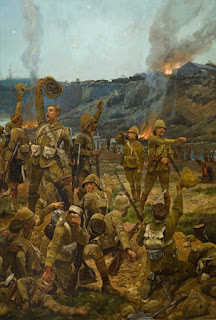
R. Caton Woodville, The Dawn of Majuba Day (depicting the victory at the Battle
of Paardeberg, February 27, 1900), c. 1900. Department of National Defence,
ZK-1938-1. Painting owned by the City of Toronto; on loan to the Royal Canadian Regiment Museum, Wolseley Barracks, London, Ontario.
of Paardeberg, February 27, 1900), c. 1900. Department of National Defence,
ZK-1938-1. Painting owned by the City of Toronto; on loan to the Royal Canadian Regiment Museum, Wolseley Barracks, London, Ontario.
The South African War (1899–1902) was Canada’s first official overseas deployment. At the Battle of Paardeberg, Canadian troops helped force the surrender of a Boer army in February 1900, a victory hailed as proof of Canada’s military maturity. Yet the war also cost 267 Canadian lives, many to disease, and sparked debate at home over the price of imperial service. Woodville’s painting depicts Canadians celebrating amid the smoke and grief of battle, the rising sun suggesting triumph and sacrifice together. Paardeberg became a symbol of national pride, loss, and the new reality of Canadian soldiers dying far from home.